Is PE self-adhesive the preferred choice for hose labels?
author: Eva
2026-11-13
Packaging for daily care and cosmetics, such as tubes for facial cleansers, hand creams or essence samples, is the first visual battlefield in brand shelf competition.
A facial cleanser, hand cream or essence sample comes with a rounded tube surface and a narrowed sealing end. When squeezed, the tube body continuously deforms – this packaging form poses a seemingly simple but extremely difficult-to-satisfy requirement for the label: to stick firmly, smoothly and for a long time.
Many brand owners and printing factories have encountered problems. Even though they chose labels that looked stiff and exquisite, expecting to create an upscale packaging, the actual labeling process often went wrong. Common issues fall into three aspects:
1、The label corners bulge and the tube tail pops open, and obvious edge warping occurs within several hours to several days after labeling;
2、The tube surface bulges and bubbles, and no matter how much pressure is applied during labeling, it is difficult to completely expel the air;
3、After squeezing the tube, the label cracks or detaches, and the sealing end undergoes layering and warping during high-temperature processing.
2、The tube surface bulges and bubbles, and no matter how much pressure is applied during labeling, it is difficult to completely expel the air;
3、After squeezing the tube, the label cracks or detaches, and the sealing end undergoes layering and warping during high-temperature processing.
Once the label warps during tube labeling, the losses are multiple: rework of labeling, waste of finished products, delay in delivery, and the warped labels on the shelves at the end will directly damage the brand image and make the packaging investment wasted.
I. What is PE Self-Adhesive Label Material
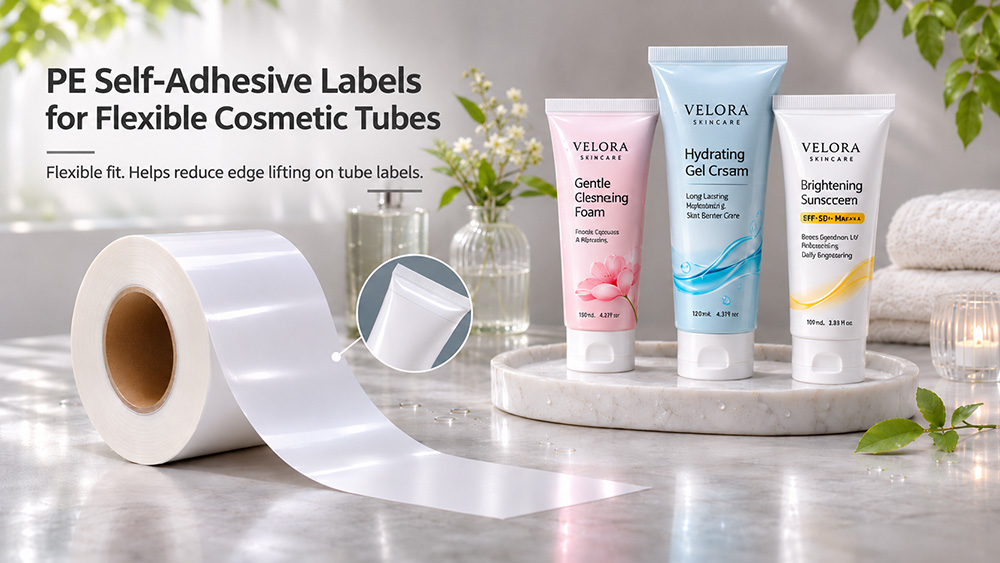
PE self-adhesive label material is a film-type self-adhesive raw material made by using polyethylene (PE) film as the surface material, combined with pressure-sensitive adhesive and backing paper.
Unlike PET and paper labels with higher stiffness, the PE substrate inherently possesses excellent flexibility, extensibility, and compression resistance, making it suitable for various curved surfaces, irregular shapes, and squeezable plastic bottle bodies and hoses. It is resistant to moisture and water, and is the core material for labeling flexible containers in the cosmetics and cleaning products industries. The entire material consists of four main parts:
PE surface material: Soft and extensible, it conforms to the deformation of the object being adhered, forming the basis of adhesion;
1. Functional layer: Determines the printing adaptability and surface performance, which is the difference between different grades of PE materials;
2. Pressure-sensitive adhesive layer: Depending on the requirements, it is combined with general adhesives, hose-specific adhesives, low-temperature-resistant adhesives, etc., of different types;
3. Backing paper: Glazed or release backing paper, serving for die-cutting, waste removal, and automatic labeling processing.
The core value of this material lies in using the flexibility and followability of the material itself to replace the "competition" between stiff materials and irregular substrates, eliminating the internal stress of warping from the source.
II. Core Comparison of Peel-and-Stick Adhesive Labels and Conventional Label Materials
|
Comparison project
|
||
|
Material properties
|
Soft and elastic
|
High tensile strength and high rigidity
|
|
Arc-shaped fit
|
Follow the deformation, remaining smooth without lifting up
|
The rebound stress is high, and the edges and corners are prone to warping.
|
|
Adaptive compression
|
Repeatedly squeezing does not cause cracking or peeling off
|
It is prone to cracking and bulging after being compressed
|
|
Post-processing at high temperature
|
The special glue is durable and does not tend to peel off
|
Ordinary glue is prone to losing its adhesion and peeling off
|
|
Waterproof and moisture-resistant
|
Membrane surface resistance to water vapor and condensate water
|
Paper is prone to deformation when exposed to moisture.
|
|
Scratch-resistant and wear-resistant
|
Ordinary
|
Stronger
|
Selection Summary: For arc-shaped squeezable containers such as hoses and soft bottles, PE self-adhesive materials should be chosen as the priority; for hard shells and scenarios requiring high scratch resistance, PET should be selected as the priority.
III. Core Advantages of PE Self-adhesive Materials
1. Exceptional Adhesion, Solving Arc Surface Creasing: The PE film is soft and has extensibility. When adhered to curved surfaces or irregular shapes, it follows the deformation of the base material, with minimal internal rebound stress, effectively reducing edge creasing and tube tail popping.
2. Resistance to Compression without Cracking: For high-frequency extruded products, the label stretches along with the tube body, without cracking or bulging, suitable for repeated compression scenarios such as facial cleansers, hand care creams, and samples.
3. Resistance to High-Temperature Sealing: When paired with soft tube-specific adhesives, it can withstand the instantaneous high temperature during sealing, significantly reducing the risk of sealing layer delamination.
4. Excellent Waterproof and Moisture Resistance: The film surface is not affected by water vapor or condensation water, suitable for use in bathroom cleaning and humid storage environments.
5. Strong Compatibility in Processing: Compatible with mainstream label printing methods such as flexographic printing, UV printing, and screen printing, supporting die-cutting, rewinding, and compatible with automated labeling production lines.
6. Excellent Chemical Stability: Resistant to the contact of small amounts of solvents from daily cleaning products, the label is less likely to corrode or be damaged.
IV. Limitations and Industry Risks of PE Self-adhesive Materials
Even though PE self-adhesive materials have significant advantages, they also have notable shortcomings that need to be evaluated before selection.
1. Low stiffness, requiring parameter adjustment for automatic labeling
PE's softness is an advantage, but in the automatic labeling process, the pre-printed length needs to be controlled within 2-5mm. If the printed length is too long, the label may become soft and sag, affecting the labeling accuracy. During production line debugging, space for adjustment needs to be reserved.
2. Low surface energy, with a threshold for pre-printing treatment
PE has low surface energy, and the adhesion of ink needs to be specially addressed. Usually, corona or coating treatment is required before printing. If the surface treatment process of the material is not mature, problems such as poor ink adhesion, ink bleeding, and blurred patterns may occur. Replacing ink or adjusting equipment still cannot completely solve the problem, as the root cause lies in the surface treatment of the raw material.
3. The selection of adhesive determines the success or failure of sealing
The temperature during the instant sealing of the hose is high, and ordinary adhesives will fail directly. The label may delaminate and curl during sealing, resulting in batch scrap. It is necessary to match soft pipe-specific adhesives or high-temperature-resistant adhesives. Improper adhesive selection is another major hidden risk for delamination recurrence.
4. Not suitable for high friction and severe wear conditions
PE film has average scratch resistance and is not suitable for scenarios where it is frequently rubbed by hard objects such as equipment casings. Such requirements should be prioritized for PET materials.
5. Poor materials bring chain brand risks
If PE materials with insufficient flexibility or incompatible adhesive systems are selected, delaminated and bulging labels will flow to the market. Consumers, seeing the rolled-off and detached labels, will directly question the product quality, damaging the brand reputation. At the same time, it will cause reprinting and scrap at the printing factory, order delays, and other losses.
To address the industry's pain points, we have independently developed a PE self-adhesive solution suitable for hose conditions, optimizing the flexibility of the base material and the matching of the adhesive system. We improve common problems such as arc surface delamination, compression cracking, and sealing layer delamination from the source of the base material. This material has been verified through project implementation by a globally renowned self-adhesive solution provider and has stable performance in batch production conditions.
V. Typical Application Scenarios
1. Daily Care and Hygiene Hose: Facial cleanser, hand cream, body lotion, shampoo hoses. The curved surface fits perfectly and does not crack when squeezed. This is the core application scenario for PE self-adhesive materials.
2. Cosmetics Hoses and Samples: Essence, sunscreen, trial packs. The thin, highly extensible PE film follows the shape of the tube and does not separate or bulge after being sealed and processed at high temperature.
3. Skin Care Extrusion Bottles: Flexible plastic bottle body labeling. It adheres without warping or bulging when squeezed.
4. Products requiring resistance to humid environments: Bathroom products, refrigerated product packaging labels. Resistant to water vapor condensation.
5. Brand Differentiation Packaging Projects: Seeking the most perfect curved surface fit and long-term shelf stability for mid-to-high-end hose packaging solutions.
VI. Q&A Common Questions and Answers
Q1: The soft hose label peels off shortly after being attached. Is it a problem with the glue or the material?
A: Both could be the cause. However, in industry, a large number of cases indicate that the root cause lies in the mismatch between the material's flexibility and the adhesive system. If the label has high rigidity and a large rebound stress, after the hose is squeezed, the label "holds firm" and the edges and corners peel off first; if the glue has insufficient initial adhesion or poor heat resistance, the sealing end will also delaminate and raise up. Our PE self-adhesive label uses a flexible base material and a hose-specific adhesive to reduce the risk of peeling at the seal.
Q2: How to choose between PE labels and PET labels? What is the core difference?
A: PE is soft and stretchable, suitable for hoses and squeeze bottles. Labels on bottles that are squeezed and deformed are less likely to crack or peel off; PET has high rigidity and hardness, better resistance to scratches, but it is hard and non-stretchable. Labels on hoses squeezed will easily burst. If your product is a cleaning hose, choose PE first; for hard shells and those seeking high scratch resistance, choose PET. You can also select quickly by referring to the comparison table above.
Q3: What are the requirements for PE self-adhesive labels in terms of printing processes? Can ordinary ink be directly printed?
A: It is not recommended to use ordinary paper ink. The PE surface has low surface energy, so it is better to use UV ink or UV flexographic ink that is compatible with films. Before printing, it is necessary to complete corona or coating treatment. Even if the ink is selected correctly, if the surface treatment quality of the substrate is poor, printing defects will still occur. It is recommended to conduct on-machine printing and labeling tests with actual rolls before the formal large-scale production, and conduct tests for tape adhesion and abrasion resistance.
Q4: What causes the label to delaminate and raise up at the hose seal?
A: The seal temperature is high at that moment. Ordinary glue fails under high temperature. The label delaminates and raise up at the seal. The solution is to match a hose-specific glue or a high-temperature-resistant glue, and confirm the adhesive retention ability of the material under the seal working conditions. Before the formal large-scale production, conduct a seal simulation test.
Q5: The prices of PE self-adhesive labels on the market vary greatly. What are the risks of low-priced materials?
A: Many low-priced products simplify the surface treatment process and only perform simple corona treatment. The corona effect will weaken with storage time, and after long-term storage, the printing performance will further deteriorate; the glue may also be a general glue rather than a hose-specific glue. In the short term, purchasing costs are saved, but in reality, it will lead to label peeling, printing failure, rework, and customer complaints, resulting in a higher overall cost.
VII. Summary
PE self-adhesive materials are an excellent choice for addressing the problems of poor adhesion and edge lifting when applying on curved or irregular substrates. They are flexible and can follow the deformation of the hose, resistant to compression without cracking, waterproof and moisture-resistant. They can enhance the long-term flatness and texture of soft tube packaging for cosmetics.
However, the effectiveness of this adhesion is highly dependent on the compatibility between the film material's flexibility and the adhesive system. There is a significant disparity in material quality in the market. Materials with insufficient flexibility or improper glue selection can cause problems such as edge lifting during labeling, separation at the sealing end, and batch scrap. These issues lead to waste of costs and damage to the brand.
When choosing PE self-adhesive materials, it is not only about whether they are soft or not, but also about whether the glue matches the hose working conditions, whether the surface treatment supports stable printing, and whether it undergoes actual labeling verification.
Instiker has developed a self-adhesive PE solution specifically for hose applications. This solution has been verified by leading self-adhesive manufacturers and has improved the arc surface adhesion and anti-compression performance from the source.
It helps printing factories and brands avoid edge lifting rework risks and stabilize the output of flat and high-quality soft tube label products. When selecting the material, a comprehensive assessment should be made based on budget, labeling substrate, usage environment, and printing process to fully leverage the value of this material in cosmetics soft tube labeling.
Analysis of BOPP Double Stretching
Related Article
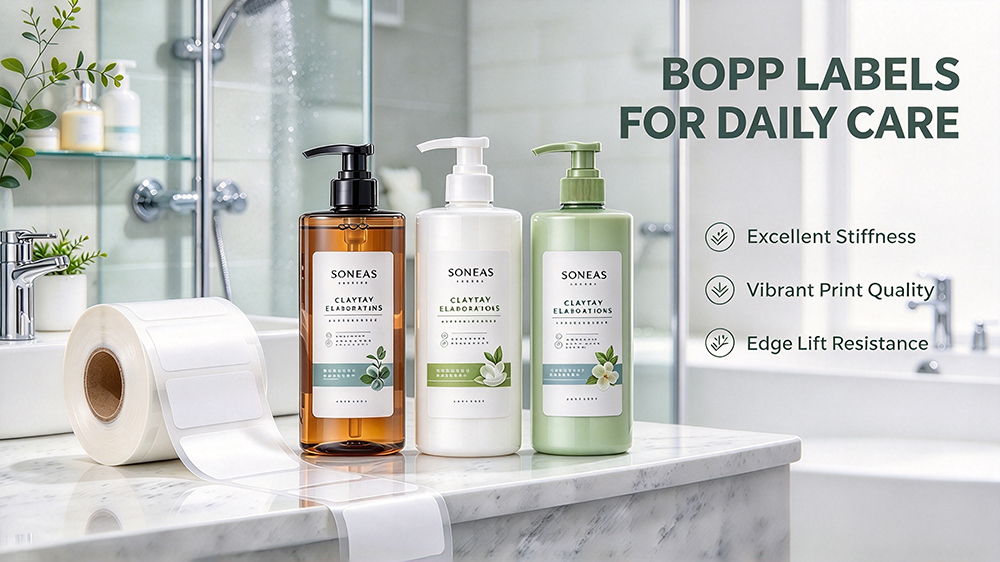
BOPP double dtretching label quality depends on substrate, coating, curing, slitting tension & liner, governing print, labeling and weather performance
Analysis of BOPP Double Stretching
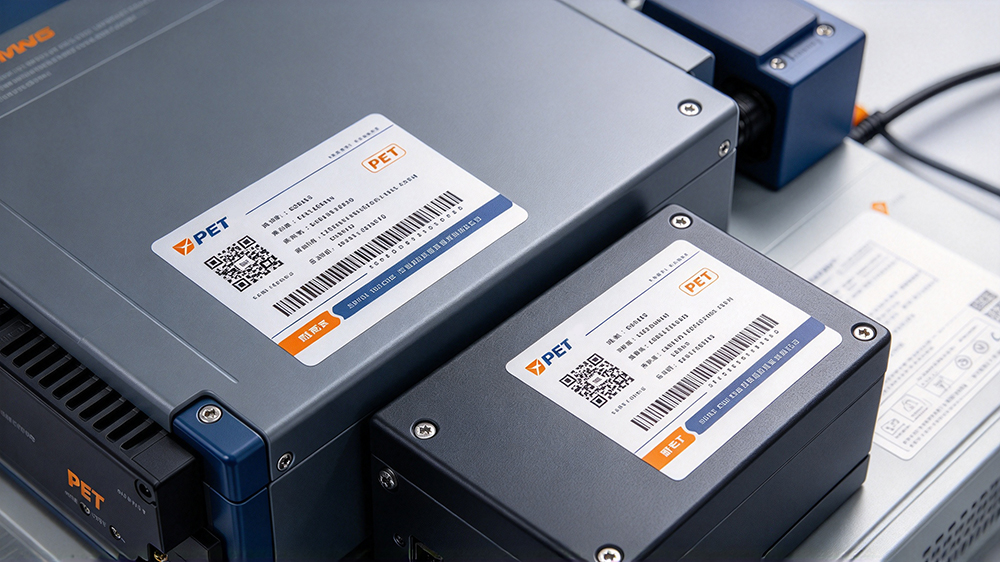
Las etiquetas PET resisten el arrugamiento, la deformación, la pérdida de tinta, el cambio de tamaño y el manchado por tinta durante la producción a alta temperatura y la impresión digital con láser.
Comprehensive Analysis of PET Self-adhesive Labels