Comprehensive Analysis of PET Self-adhesive Labels
author: Eva
2026-10-13
Will the labels you are using have the following drawbacks?
Common self-adhesive labels have several drawbacks in scenarios such as electronic product identification and laser digital printing:
The fusing unit of the laser printer can reach temperatures above 200℃. Ordinary paper or PP material labels tend to curl, deform, and have poor carbon powder adhesion when exposed to high temperatures, resulting in blurred barcodes that cannot be scanned.
When PCB circuit boards undergo reflow soldering, the labels may lift, fall off, and turn yellow, causing the traceability information to be lost.
During the use of electronic products, they experience temperature changes, and the size of the ordinary labels becomes unstable, leading to problems such as contraction, blistering, and edge warping.
I. What is a PET labels?
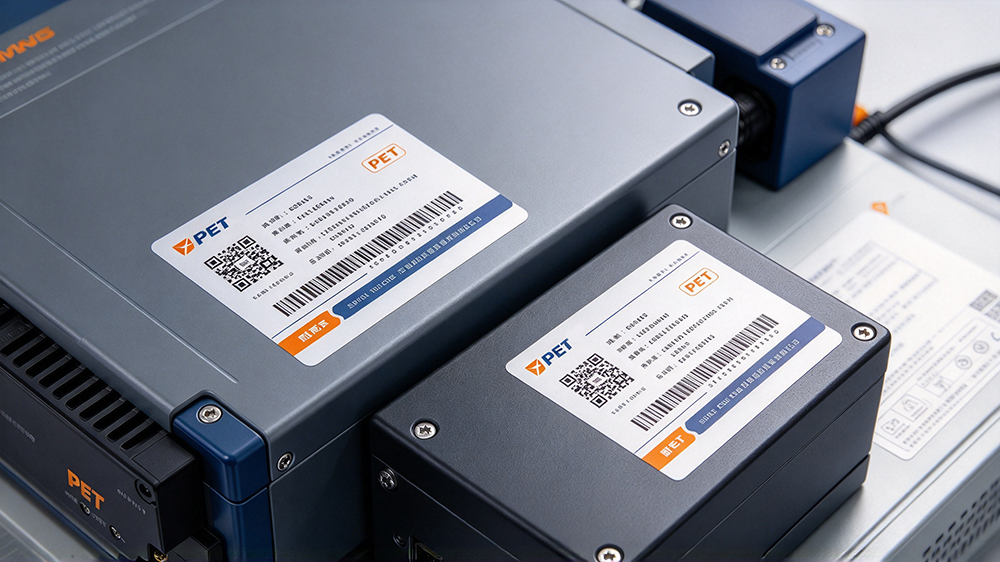
PET labels are heat-resistant self-adhesive labels. The substrate material of Instiker products is made of PET polyester film. The core difference from ordinary self-adhesive labels lies in the temperature resistance and dimensional stability of the base material itself. It is mainly composed of PET substrate, special high-temperature-resistant adhesive layer, and release liner. Depending on whether the surface has a printed coating, it is divided into PET labels with coating and PET labels without coating.
Coated PET vs Uncoated PET
PET labels are classified into two types based on their surface treatment methods: those with coatings and those without. The main difference lies in their adaptability for printing and lithography:
|
Comparison
|
Coated PET label
|
Uncoated PET label
|
|
Surface treatment
|
An additional special printing coating is added to the surface of the PET material
|
The surface of the PET material has no additional coating and is a bare membrane
|
|
Printing method
|
Laser printing, thermal transfer printing and inkjet printing are all possible
|
Mainly compatible with thermal transfer printing. For laser printing, a dedicated model is required
|
|
Adhesion of toner/ink
|
Strong, the carbon powder is firmly anchored and does not easily smudge
|
Weaker and ordinary laser printing is prone to powder shedding and ink bleeding
|
|
Barcode clarity
|
High, with sharp edges, and high scanning rate
|
Generally, a special carbon paper is required for matching.
|
|
Cost
|
Higher
|
Lower
|
|
Applicable scene
|
Laser digital printing, QR code/serial number printing, electronic product labels
|
Thermal transfer labels, simple identification, scenarios with limited budget
|
PET Model Selection Tips: ① If laser printing, printing QR codes/serial numbers is required and ink retention is needed, choose PET with coating; ② For thermal transfer printing, simple identification content and limited budget, choose PET without coating; ③ For high-temperature processing and long-term clear printing content, recommend choosing high-temperature-resistant PET with coating.
Comparison of Main Types of PET Labels
|
Type
|
Core feature
|
Temperature resistance performance
|
Printing adaptation
|
Merit and Demerit
|
Applicable scene
|
|
Standard coated PET
|
25μm PET surface material, universal high-temperature resistant coating + upper layer printing coating
|
-40℃ to +149℃ for a long term
|
Laser printing / Thermal transfer printing
|
Advantages: High cost-effectiveness, no ink bleeding during printing;
Disadvantages: Requires a dedicated model for ultra-high temperature processing.
|
Electronic product nameplates and barcode labels
|
|
High-temperature-resistant coating PET
|
50μm PET surface material, enhanced temperature-resistant coating + upper layer printing coating
|
Short-term resistance to temperatures above 200℃
|
Laser printing
|
Advantages: High temperature resistance level, suitable for reflow soldering;
Disadvantages: High cost.
|
PCB traceability labels, high-temperature process markings
|
|
PET without coating
|
25μm/50μm PET film material, bare film without coating
|
-40℃ to +149℃ for a long term
|
Thermal transfer printing is the main method.
|
Advantages: Low cost;
Disadvantages: Laser printing is prone to ink bleeding, and special carbon paper is required.
|
Thermal transfer labels, simple identification markers
|
|
PET surface material + matte silver coating + upper layer printing coating
|
-40℃~+149℃
|
Laser printing/Thermal transfer printing
|
Advantages: High-end appearance, scratch-resistant;
Disadvantages: Print parameters need to be adjusted
|
High-end electronic nameplates and equipment labels
|
|
|
Transparent PET surface material + upper layer printed coating
|
-40℃~+120℃
|
Laser printing / Thermal transfer printing
|
Advantages: Invisible and aesthetically pleasing, without obscuring the product's appearance;
Disadvantages: The temperature resistance is slightly lower than that of the standard type.
|
Precise appearance component identification, mirror surface products
|
II. For whom to design it? Who needs it the most?
Companies that attach importance to product traceability management and require reliable identification of high-temperature processing procedures;
Manufacturers of digital products, home appliances, PCBs, etc. that need laser digital printing labels;
Electronic component manufacturers such as batteries and components that have requirements for temperature resistance and chemical resistance;
Electronic factories that need to control production line traceability and factory origin traceability;
Government and enterprise units that need to make long-term identifications for equipment and instruments;
Label purchasing personnel who need to distinguish printing methods and select models as needed.
III. Frequently Asked Questions
Q1: Why do carbon powder fall off or get smudged when PET labels are printed on a laser printer?
A: Most likely, the fixing temperature or speed parameters of the printer do not match those of the PET labels, or the PET labels without coating are selected, or the compatibility between the coating and the carbon powder is insufficient. It is recommended to choose PET label models with an upper printing coating, specifically designed for laser printing, and adjust the printer parameters to the recommended values to ensure that the carbon powder is firmly anchored and does not smudge.
Q2: How to choose between coated PET and uncoated PET?
A: Based on the printing method and content requirements: for laser printing, printing QR codes/serial numbers, and requiring no smudging, choose coated PET; for only heat transfer printing, simple identification content, and limited budget, choose uncoated PET. Both have basically the same temperature resistance performance, with the main difference lying in printing adaptability.
Q3: Why do PET labels curl or fall off after reflow soldering?
A: It may be due to insufficient glue temperature grade, or there is oil or dust on the surface of the adhesion. It is recommended to choose high-temperature-resistant PET label models, ensure the surface is clean, flat, and dry before sticking, and press firmly during the labeling process.
Q4: How to choose PET labels, PP labels, and PVC labels?
A: Prioritize the use temperature and printing method: for laser digital printing and high-temperature processing, select coated PET labels; for normal temperature identification, limited budget, select PP labels; for soft and waterproof but low-temperature resistance requirements, select PVC labels; for extreme processing temperatures over 200°C, choose PI labels.
Q5: Which surfaces are not suitable for using PET labels?
A: Rough porous, powder-losing, rubber soft surfaces, oily and damp, un-cured coating surfaces are prone to curling and poor adhesion, and are not recommended for direct use. Strong adhesive models or surface treatment should be selected instead.
Q6: Can PET labels be customized with QR codes and serial numbers?
A: Yes. Coated PET substrate supports laser printing and heat transfer printing, and can print LOGOs, QR codes, and serial numbers to achieve physical identification and digital traceability integration. Multiple processes can be customized.
Q7: Does the curling of PET labels always indicate a quality problem of the labels?
A: Not necessarily. Curling may be related to the surface of adhesion, environmental temperature, labeling pressure, glue selection, etc. It is recommended to investigate based on specific usage conditions and contact the supplier for technical support if necessary.
Q8: How to choose PET labels, fragile paper, and VOID labels?
A: For high-temperature resistance, laser digital printing, long-term identification, and no smudging, select coated PET labels; for labels that tear easily and are anti-opening, select fragile paper; for anti-opening and anti-counterfeiting requirements, select VOID labels; for high protection projects, PET high-temperature-resistant labels and VOID anti-opening labels can be combined.
IV. Summary
PET labels are an effective solution to the problems of curling, deformation, carbon powder shedding, unstable size, and ink bleeding in the high-temperature manufacturing process and laser digital printing scenarios of ordinary labels.
By leveraging the temperature resistance, dimensional stability of the PET substrate, and the optional upper printing coating, PET labels can achieve reliable output of electronic product identification under extreme conditions.
According to surface treatment, they are divided into two categories: coated PET and uncoated PET: Coated PET does not bleed ink and is suitable for laser digital printing and QR code printing; Uncoated PET has a lower cost and is suitable for thermal transfer printing and simple identification.
There are also PET, PVC, paper, and PI materials in the market that compete with self-adhesive materials, each having their own advantages and disadvantages. They need to be selected based on specific requirements.
Analysis of the VOID anti-counterfeiting label
Related Article
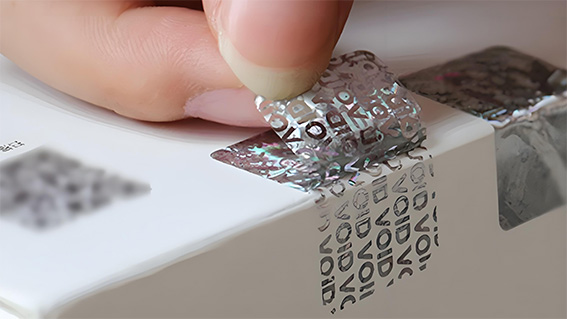
VOID anti-counterfeiting label rely on a physically destructive structure that leaves marks upon peeling, delivering tamper-proof protection at low cost.
Analysis of the VOID anti-counterfeiting label
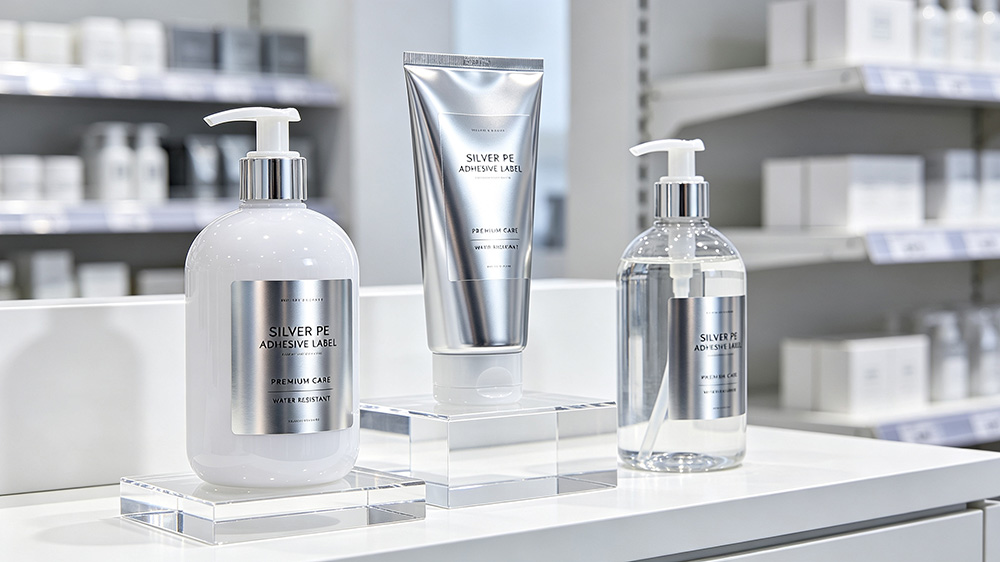
Selecting bright silver PE self-adhesive material depends not only on surface brightness, but also coating process and actual printing verification.
Analysis of Bright Silver PE Self-Adhesive Material