Analysis of the VOID anti-counterfeiting label
author: Eva
2026-09-30
Does your product label have the following issues?
1、The ordinary labels have the risk of being torn off completely and then reattached, making it impossible to determine whether the product has been tampered with privately.
2、Some labels, when peeled off, have no anti-counterfeiting marks, allowing criminals to complete the theft of goods, substitution, and re-packaging. Consumers find it difficult to distinguish whether it is an original and brand-new product.
This situation directly harms the consumer's rights and interests, resulting in purchasing counterfeit or refurbished products, leading to poor user experience; At the same time, it causes huge losses to the brand owners, Counterfeit products are rampant, damaging the brand's reputation.
I. What is a VOID anti-counterfeiting label?
The VOID anti-counterfeiting label is a one-time anti-tamper and anti-counterfeiting self-adhesive label. This product's substrate material is PET. The core difference from ordinary permanent self-adhesive labels lies in the special layered damage structure inside the label.
It is mainly composed of PET substrate, special damage adhesive layer, and release base paper. It can support thermal transfer printing, laser printing, and can print customized contents such as QR codes, serial numbers, graphic logos, etc.
When the label is attached properly, its appearance is normal. Once the label is forcibly removed, the internal structure of the label will peel off and be damaged, revealing the "VOID" anti-counterfeiting words, which serves as an anti-tampering warning.
II. Main types comparison of VOID
Based on the transfer effect of the characters revealed after being lifted, it is classified into three categories: full transfer, partial transfer, and no transfer. Each category further distinguishes between the negative plate and the positive plate character patterns.
|
Type
|
Reveal the final effect
|
Font template storage location
|
Label adhesiveness
|
Advantages and disadvantages
|
Applicable
|
|
The negative has been completely converted to VOID
|
The VOID pattern is completely transferred to the surface of the attached object, and the label material presents a hollowed-out appearance.
|
The surface of the object being adhered to
|
Completely loses stickiness and cannot be reattached.
|
Advantages: High level of anti-counterfeiting, the evidence left on the object is conclusive.
Disadvantages: High cost.
|
High-end digital products, medical equipment, and confidential device original factory seals
|
|
The entire positive plate has turned to VOID
|
The VOID entity mold remains on the lifted label material, while the attached object leaves a hollowed-out pattern beneath it.
|
The exposed label surface material
|
Completely loses adhesiveness and cannot be reattached.
|
Advantages: It can preserve the labels as physical evidence, making it easy to trace. Disadvantages: The attached items do not have direct warning labels.
|
Scenarios where it is necessary to preserve physical evidence such as labels and legal document seals
|
|
Negative half rotation VOID
|
The solid VOID font is left on the object, while the label material simultaneously features a complementary hollow pattern.
|
The surface of the object being adhered to
|
Maintain slight stickiness and can be temporarily reattached.
|
Advantages: Leaves marks on both sides, widely used in the market.
Disadvantages: Residual adhesiveness may lead to misjudgment.
|
Consumer electronics, auto parts, gift box packaging
|
|
Positive plate half rotation VOID
|
The solid VOID mold remains on the PET material, and the surface of the attached object retains the hollow patterns.
|
The exposed label surface material
|
There is still some residual stickiness, so it can be temporarily reattached.
|
Advantages: The evidence labels are preserved. There are damage marks on both sides.
Disadvantages: The adhesive residue may lead to incorrect judgments.
|
The archival seals and the authorization labels must retain the physical evidence of the labels.
|
|
Don't transfer VOID
|
The anti-counterfeiting characters only appear on the PET label material. The surface of the object to which it is attached has almost no glue or residue.
|
The exposed label surface material
|
Loss of stickiness
|
Advantages: It does not damage the surface of the object being adhered to, and is suitable for high cleanliness products.
Disadvantages: There is no background warning on the object being adhered to, and the anti-counterfeiting effect is relatively weak.
|
Mirror surface, precise exterior components. The items to be adhered must not have any residual adhesive residue.
|
Tips: Negative plate = the letter mold remains on the substrate being attached; Positive plate = the letter mold remains on the peeled label surface material; Full transfer = the adhesive layer is completely transferred, resulting in the label losing adhesion; Partial transfer = both sides leave marks, and the label retains a weak degree of stickiness.
Comparison of Similar Anti-counterfeiting Self-adhesive Materials
|
Material type
|
Core anti-counterfeiting principle
|
The performance after opening the package
|
Material
|
Advantage
|
Disadvantage
|
Applicable scene
|
|
The adhesive layer has become delaminated and transferred, revealing the hidden characters.
|
When the "VOID" / "OPENED"appears; you can choose to keep the characters on the product surface or on the label surface. The mark will remain permanently and irreversibly.
|
PET
|
It can achieve the function of leaving fingerprints on the object for evidence collection; it is resistant to water and friction.
|
The cost is higher than that of ordinary labels; rough / oily surfaces are prone to triggering abnormalities.
|
3C electronic products and instruments warranty labels, auto parts, gift boxes, equipment cabinet seals
|
|
|
Optical grating holographic patterns can be verified through visual optical variation effects; they have no anti-tampering capability by nature.
|
The label can be completely removed without any automatic damage; it requires the use of VOID adhesive to have the ability to be peeled off with a trace left.
|
BOPP
|
The appearance is of high quality, the imitation threshold is high, and it enhances the brand's texture.
|
Only surface anti-counterfeiting measures, no internal anti-duplication; special edition printing costs are high; ordinary common plates' laser printing is easily counterfeited.
|
High-end gift boxes, tobacco and alcohol, luxury goods - all feature anti-counterfeiting features on their appearance. These are often used in combination with VOID.
|
|
|
The paper base material has extremely low strength. The adhesive force is greater than the paper's tensile force. The removal process results in the paper breaking into pieces.
|
The labels broke into pieces. No printed text would appear on the product surface. Only the label itself would be destroyed.
|
Paper-based fragile substrate
|
The printing is highly adaptable and can print barcodes and QR codes.
|
Not resistant to moisture or friction; prone to breakage at high temperatures and high humidity; paper scraps are likely to remain; no product surface text for evidence collection
|
Low-price warranty stickers, small household appliance warranty labels, one-time sealing labels
|
Selection Tips: ① It is necessary to leave textual evidence on the product surface after opening it. Choose PET VOID first; ② Only the label needs to be torn off, no textual evidence is required on the product surface. For limited budgets, choose fragile paper; ③ If you want to achieve visual anti-counterfeiting effect, choose laser hologram.

III. Who needs the VOID anti-counterfeiting label the most?
1、Brands that strictly control and prevent the tampering and refurbishing of their original products
2、manufacturing enterprises for digital products, auto parts, instruments, etc. that need to define the warranty responsibilities
3、fast-moving consumer goods brands such as beverages and cosmetics that are highly prone to counterfeiting and tampering
4、factories that need to control counterfeiting and trace the origin of products during the manufacturing process
5、government and enterprise units that need to prevent the opening and tampering of equipment and confidential items and ensure their safe storage
IV. Frequently Asked Questions
Q1: The VOID label wasn't torn, but why did the word "VOID" appear on the surface automatically?
A: This is mostly due to oil stains or dust on the surface of the label, or drastic changes in environmental temperature, or the label not being pressed and compacted properly. For PET VOID labels, they need to be adhered to a clean, flat and dry surface. During the labeling process, they should be fully pressed to avoid excessive temperature differences and reduce abnormal triggering.
Q2: After tearing off the PET material VOID label, can the label be restored and reattached?
A: No. This label has a destructive layered structure; when the full transfer type is lifted, the backing material completely loses its stickiness; for the semi-transfer type, although there is a slight adhesion, both sides have left permanent anti-counterfeiting marks, and the structure has been damaged, making it impossible to restore and reattach.
Q3: How to choose between the shadow plate, the positive plate, the full transfer, and the semi-transfer?
A: First, consider whether you need to leave an evidence of opening on the product surface: if yes, choose the shadow plate; if you need the label itself to retain the imprint evidence, choose the positive plate; if you want the label to be completely unable to be reattached after being torn, choose the full transfer; if you allow the label to be briefly reattached and leave traces on both sides, choose the semi-transfer; if the product surface has no residual glue marks, choose the non-transfer VOID.
Q4: Which surfaces are not suitable for using PET VOID anti-counterfeiting labels? A: Rough porous, powdering, rubber soft surfaces, oily and damp, un-solidified coating surfaces are prone to creasing, premature character appearance, and unstable adhesion. They are not recommended for direct use.
Q5: Can PET VOID labels be customized with QR codes or serial numbers?
A: Yes. PET material supports thermal transfer and laser marking, and can print LOGOs, QR codes, and serial numbers to achieve physical anti-opening + digital traceability combination. Both shadow plate and positive plate processes can be customized.
Q6: Does the appearance of VOID marks necessarily mean the product is counterfeit?
A: Not necessarily. VOID indicates that the label has been opened, meaning there is a record of opening the product, representing a non-original seal state. It can be used as an opening evidence, but it cannot be directly equated with counterfeit products. It needs to be combined with other product information for comprehensive judgment.
Q7: How to choose between VOID, fragile paper, and laser holographic labels?
A: If you need a clear warning of clear opening on the product surface, choose VOID; if you only need the label to break when torn, and do not want the product surface to leave any marks, choose fragile paper; if you want an optical identification appearance, choose laser holographic; for high protection projects, you can combine the use of VOID + QR code + laser technology.
V. Summary and Recommendations
The VOID anti-counterfeiting label is an effective solution to the problems of ordinary labels that can be completely torn off and cannot be identified as having been opened or tampered with. It relies on the physical damage structure that leaves a trace when peeled off, achieving product anti-tampering and anti-counterfeiting at a low cost.
It has various types in terms of process, including negative plate full rotation, positive plate full rotation, negative plate half rotation, positive plate half rotation, and non-transfer.
There are also fragile paper, laser holographic, and digital anti-counterfeiting copperplate paper on the market that compete with self-adhesive materials, each having their own advantages and disadvantages. They need to be selected based on specific requirements.
VOID is widely applicable in scenarios such as electronic products, auto parts, gift boxes, and equipment storage, but it is not a universal label. Before use, it is necessary to evaluate the base material for adhesion, the usage environment, and the budget, and choose the appropriate type of negative / positive plate, full rotation / half rotation process. In some cases, it is necessary to combine with other anti-counterfeiting materials for combination and matching to avoid abnormal failure due to mismatch in surface and environment, so as to achieve the best anti-tampering and anti-counterfeiting effect.
Analysis of Bright Silver PE Self-Adhesive Material
Related Article
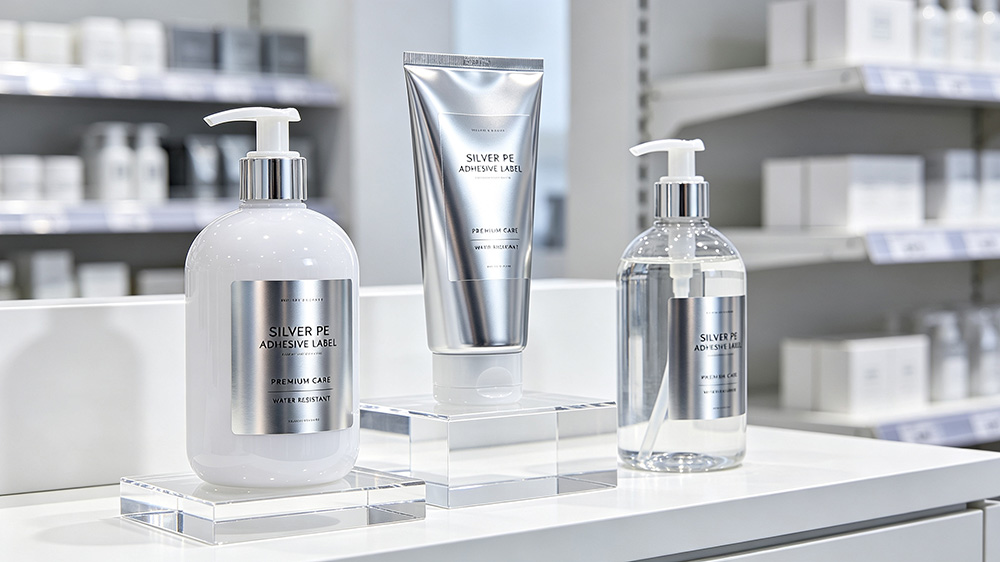
Selecting bright silver PE self-adhesive material depends not only on surface brightness, but also coating process and actual printing verification.
Analysis of Bright Silver PE Self-Adhesive Material

Labels are not just for decoration. In the field of daily personal care products, they serve as carriers of information.
Guide to Selecting Materials for Daily Personal Care Product Labels