
Analysis of the application of environmentally friendly labels
author: Eva
2026-03-24
Environmentally friendly labels are widely used in a wide range of products, including industrial new materials, consumer goods, and packaging consumables.
Instiker has been deeply engaged in the field of environmental-friendly new materials. Its main business includes environmentally friendly labels substrates, functional environmentally friendly identification materials, and related printing processing services. It provides services to numerous downstream enterprises such as packaging, food, cosmetics, electronics, rubber and plastic, etc.
I. The limitations of the application of environmentally friendly labels and the challenges faced by the industry
1. The certification system is complex and has low recognition across regions
There are numerous types of environmentally friendly labels both domestically and internationally. The domestic green product labels, carbon footprint labels, degradable labels, and the EU's Eco-label, US Green Label, etc. do not have a unified standard. The certification rules vary significantly across different regions and product categories.
2. The certification and implementation costs are relatively high, putting pressure on small and medium-sized enterprises
The environmentally friendly labels require payment of certification fees, annual review fees, and costs for setting up the traceability system. At the same time, enterprises need to invest manpower to complete tasks such as data collection, process improvement, and document filing.
3. Delay in standard updates and insufficient adaptability
The iteration speed of existing environmentally friendly labels certification standards is slower than the innovation speed of new materials. Some new biodegradable materials and low-carbon composite materials currently lack corresponding exclusive identification standards, resulting in the inability of high-quality environmental-friendly new materials to precisely match the regulatory labels, and causing problems such as products meeting standards but having inconsistent labels.
4. Frequent incidents of industry misconduct, and the risk of greenwashing is particularly prominent.
There are a large number of un-certified and counterfeit false environmentally friendly labels in the market. Some enterprises abuse the green logo merely through promotional rhetoric without any actual test data to back it up.
5. Incomplete market understanding and limited conversion efficiency
Young consumers have a relatively high awareness of environmentally friendly labels. However, in lower-income markets and traditional industrial procurement sectors, the ability to distinguish different grades and categories of environmentally friendly labels is relatively weak. This results in some enterprises, after investing in cost certification, being unable to effectively convert their efforts into market orders, and thus achieving a low return on investment.
II. For whom is it designed? Who needs to use it?
(1) New material substrate manufacturing enterprises
Environmental protection material enterprises, represented by Instiker are the core research, production and implementation entities of environmentally friendly labels.
These enterprises need to showcase the core advantages of their substrate's degradability, low VOC emissions, low carbon emissions, and no heavy metals through standardized environmentally friendly labels, providing compliant and traceable environmental protection identification support services for downstream customers, and enhancing product value and industry competitiveness.
(2) Industrial manufacturing enterprises
Covering packaging printing, food and daily necessities, electronic and electrical, rubber and plastic products, home building materials and other industries.
The products of these enterprises directly face the market. They need to rely on environmentally friendly labels to complete compliance registration, product quality inspection, and at the same time, through green labels to enhance brand image, meet the green procurement entry requirements of supermarkets, brands, and fulfill the corporate social responsibility, while meeting the policy green procurement assessment requirements.
(3) Terminal trading and procurement platforms
Large supermarkets, e-commerce platforms, government procurement units, brand chain enterprises regard environmentally friendly labels as the core evaluation standard for green procurement.
They prioritize the purchase of products with formal environmentally friendly labels to improve their own green supply chain system, fulfill corporate social responsibility, and at the same time meet the policy green procurement assessment requirements.
(4) Terminal consumers
With the popularization of green consumption concepts, consumers are increasingly concerned about the environmental attributes of products.
Environmental protection labels provide consumers with intuitive and authoritative purchasing basis, helping consumers quickly identify green products, avoid false green products, and reduce the decision-making cost of green consumption.

III. Case Analysis
Case 1: Food Biodegradable Packaging Label Matching Project
Challenge
The original ordinary paper labels of the enterprise had no environmental certification and could not enter the high-end supermarket channels. Moreover, they did not meet the low-carbon compliance requirements for food packaging.
Solution
Matched with national standard biodegradable eco-friendly labels, using PLA biodegradable base material.
Result
The customer's products successfully passed the green entry review of supermarkets and successfully entered high-end chain supermarkets.
Case 2: Upgrade Project of Low-Carbon Labels in the Electronics Industry
Challenge
An electronic accessory manufacturer previously used ordinary self-adhesive labels that contained trace amounts of harmful additives, which failed to meet the EU RoHS environmental standards. Their cross-border exports were repeatedly hindered.
Solution
Instiker customized low-carbon, halogen-free, and environmentally friendly labels for them and obtained the auxiliary certification from the EU Eco-label.
Result
This completely resolved the green barrier issues for product exports, with a 100% pass rate for customs clearance, and avoided the risk of environmental penalties from overseas.
IV. Traditional ordinary labels vs Modern eco-friendly labels
|
Comparison dimension
|
Traditional ordinary label
|
Modernized compliance and environmentally friendly labels
|
|
Environmental protection attribute
|
Non-biodegradable, with residual additives and high carbon emissions
|
Biodegradable, low VOC, no harmful residues, low carbon emissions
|
|
Compliance
|
Without environmental certification, it is impossible to connect with green procurement or cross-border trade.
|
Compliant with national standards and EU standards, traceable, verifiable, and without compliance risks.
|
|
Added value
|
Only identification information, without premium capabilities or brand empowerment
|
Empower product pricing and create a differentiated competitive advantage
|
|
Functionality
|
Single function, only basic printing and marking.
|
Waterproof, high-temperature resistant, traceable, intelligent interaction, suitable for industrial scenarios
|
|
Cost
|
Low cost, no additional certification fees
|
The cost is slightly higher by 5% to 20%, but the long-term cost-effectiveness is better.
|
|
Market adaptability
|
Only suitable for the low-end market and ordinary distribution channels
|
Suitable for all channels of high-end supermarkets, foreign trade, and government procurement
|
V. Question Answering
Q1: What is the fundamental difference between environmental labels and ordinary labels?
The core difference lies in the environmental properties of the base material, compliance certifications, and added value.
The core difference lies in the environmental properties of the base material, compliance certifications, and added value.
Q2: Do all products need to apply for an environmental label?
Not all of them do. Products in the lower-end circulation category, those without green procurement requirements, and those without foreign trade business can use regular labels.
Q3: How long does the environmental label certification process take? And what is the approximate cost?
The certification process for domestic basic green labels takes 1-2 months, while the international EU Eco-label certification process takes 3-6 months.
Q4: Can the environmental labels be applicable to all industries?
No. Different industries have their own specific standards.
Q5: What impacts will there be if there are no environmentally friendly labels?
Internally, it will be impossible to complete the green compliance filing, and there will be risks of quality inspection rectification; externally, it will be unable to enter high-end supermarkets, government procurement, and cross-border markets.
VI. Summary
The environmental label serves as a crucial tool for the green transformation, market competition and compliant operation in the new materials industry, and it encompasses compliance value, economic value and brand value.
Although there are current limitations such as high certification costs, inconsistent standards, and chaotic market conditions, with policy regulation, technological upgrades, and industry evolution, its application advantages will continue to be prominent.
For Instiker and its upstream and downstream enterprises, accurately matching their own business scenarios, implementing the application of environmentally friendly labels in a hierarchical, compliant, and refined manner, can not only avoid green operation risks, but also tap into product premium space and expand market channels. This is an inevitable choice for adapting to the dual carbon trend and achieving long-term development of the enterprise.
In the future, relying on digital, customized and standardized environmentally friendly labels solutions, the new materials industry will achieve a comprehensive upgrade from passive compliance to active green value creation.
The anti-counterfeiting principle and price of laser stickers
The principle and effectiveness of anti-counterfeiting labels
Related Article

Las etiquetas PET resisten el arrugamiento, la deformación, la pérdida de tinta, el cambio de tamaño y el manchado por tinta durante la producción a alta temperatura y la impresión digital con láser.
Comprehensive Analysis of PET Self-adhesive Labels
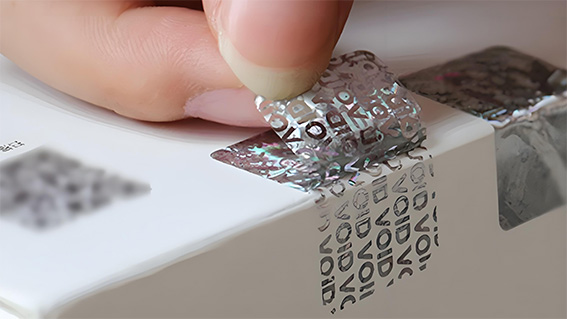
VOID anti-counterfeiting label rely on a physically destructive structure that leaves marks upon peeling, delivering tamper-proof protection at low cost.
Analysis of the VOID anti-counterfeiting label