The anti-counterfeiting principle and price of laser stickers
author: Eva
2026-03-25
In the current era where counterfeit and substandard products are rampant, laser stickers have emerged as the core choice for brands to protect their products and maintain market order. They not only serve as the identification of the products but also play a crucial role in anti-counterfeiting and traceability, as well as enhancing the brand's quality. When many enterprises and consumers come into contact with laser stickers, they often have three major questions: How exactly do laser stickers achieve anti-counterfeiting? Are their prices high? And how do the manufacturers of self-adhesive stickers produce these stickers that are both practical and anti-counterfeiting? Let's break down these questions and provide a comprehensive understanding of the core knowledge of laser stickers.
I. What is the anti-counterfeiting principle of laser stickers?
The core of the anti-counterfeiting feature of laser stickers lies in leveraging laser technology and optical principles to create unique characteristics that are visible to the naked eye and difficult for counterfeiters to replicate. The anti-counterfeiting methods are mainly divided into three categories, which are progressively built to form a protective system, taking into account both convenient identification and high security.
The most intuitive anti-counterfeiting method is laser holographic anti-counterfeiting. This type of sticker relies on the principles of light interference and diffraction. By using laser beams to engrave, etch or coat special structures on the surface of the film, it forms holographic patterns with dynamic visual effects - such as 3D logos, rainbow gradient textures, dynamic displacement patterns, etc. These patterns will present different colors and shapes under different angles and light irradiation. They can be quickly identified by the naked eye, while ordinary printing equipment cannot replicate this precise optical structure. Just like the stickers on common tobacco, alcohol, and cosmetics, when turned, one can see the three-dimensional patterns with flowing colors. This is the most typical laser holographic anti-counterfeiting effect.
The advanced anti-counterfeiting method is laser micro-engraving and invisible anti-counterfeiting. The manufacturer will use high-precision laser equipment to engrave micron-level miniature characters, exclusive textures or invisible QR codes on the sticker. These details are indistinguishable to the naked eye and can only be observed with a magnifying glass or a dedicated scanning device; some stickers will have unique anti-counterfeiting codes burned out through laser on a special coating. Combined with the enterprise database, it realizes "one item, one code" traceability. Consumers can verify the authenticity of the product by scanning, and even if counterfeiters can imitate the surface patterns, they cannot replicate these tiny and unique anti-counterfeiting information.
The most advanced form is multi-layered anti-counterfeiting technology, which combines laser anti-counterfeiting with other techniques to create a three-dimensional protection. For example, incorporating fluorescent anti-counterfeiting into laser stickers, which shows no abnormalities under normal light but will display a unique fluorescent pattern when exposed to ultraviolet light; or combining digital encryption technology to embed product information and traceability data into laser patterns, making counterfeit products impossible to hide. This multi-layer anti-counterfeiting method is widely used in high-end luxury goods and high-end pharmaceuticals, which have extremely high requirements for anti-counterfeiting.
II. What factors affect the price of laser stickers?
Many people mistakenly believe that laser sticker technology is highly sophisticated and the price must be very high. However, in reality, the price range of laser stickers is quite wide, ranging from a few cents to several dozen yuan. The core factors determining the price depend on product specifications, customization requirements, production quantity, etc., and are not universal. Ordinary enterprises and small brands can also easily afford it.
Firstly, production quantity is the core factor affecting the unit price. Mass production can significantly reduce the cost of each sticker. For example, when the production volume reaches over 100,000 pieces, the unit price will decrease significantly; while small batch orders, due to equipment debugging, material loss, etc., the unit price will be relatively higher. Some manufacturers set minimum order quantities, and usually the higher the minimum order quantity, the more favorable the unit price is. This is why the cost of purchasing laser stickers for large enterprises is lower.
Secondly, the complexity of the design and the level of anti-counterfeiting directly determine the price. The standard laser stickers have the lowest price, with a single cost usually ranging from 0.5 yuan to 2 yuan, suitable for ordinary consumer products. While customized stickers, such as those requiring the design of exclusive holographic patterns, adding microtexts, fluorescent anti-counterfeiting, digital traceability and other functions, will significantly increase the design and craftsmanship costs, with the unit price possibly reaching 2 yuan to over 10 yuan. Moreover, the larger the size of the label and the more irregular its shape, the more materials and labor hours are required, and the price will accordingly increase.
Finally, the materials and processes also affect the price. The quality of the paper used varies greatly, resulting in significant differences in cost. Ordinary coated paper and writing paper have lower costs, while high-end materials such as PET, PVC, aluminum-coated films, and synthetic paper have much higher prices. The precision of the laser process also influences the cost; the more precise the laser engraving and etching techniques, the higher the technical requirements and the higher the cost. For example, laser stickers used in high-end luxury products often employ special materials and high-precision holographic techniques, so the unit price is naturally higher. In contrast, laser stickers for ordinary daily products use basic materials and techniques, and the prices are very affordable.
Overall, the prices of laser stickers show a tiered pricing characteristic: the basic model has an extremely high cost-effectiveness and is suitable for daily anti-counterfeiting of small and medium-sized brands; the mid-to-high-end model is suitable for brands with higher anti-counterfeiting requirements; the high-end model is suitable for luxury goods, high-end pharmaceuticals and other fields, and although the price is high, it can effectively safeguard brand value. In recent years, with the popularization of laser technology, the prices of laser stickers have generally stabilized and even decreased, further reducing the usage threshold for enterprises.

III. What are the steps involved in producing laser stickers by non-woven adhesive manufacturers?
Most laser stickers are made of non-woven adhesive material and do not require additional application of glue. They are easy to use and widely applied to various products. The production of laser stickers by non-woven adhesive manufacturers is a precise process that integrates material selection, laser processing, and non-woven adhesive bonding. It mainly consists of five core steps, and each step directly affects the anti-counterfeiting effect and user experience of the stickers.
The first step is that Instiker will select the appropriate face paper, base paper and adhesive layer based on the customer's requirements: The face paper can be chosen from copperplate paper, PET, PVC, aluminum-coated film, etc. Among them, laser anti-counterfeiting labels often use laser film, PET and other materials, which are convenient for laser engraving and presenting holographic effects; the base paper mostly uses silicon-coated release paper, which serves to protect the adhesive layer and is convenient for subsequent peeling use; the adhesive layer is selected according to the usage scenario, such as acrylic hydraulic pressure-sensitive adhesive, hot melt pressure-sensitive adhesive, etc. At the same time, 0.1-6mm of no-adhesive edges will be left around the face paper and base paper to avoid ink overflow and contamination of equipment or affecting the appearance when laser printing or use is carried out later. In addition, for materials with smooth surfaces such as PET and PVC, Instiker will also perform laser pre-treatment on the base material surface to micro-etch and roughen the surface, improving the adhesion for subsequent printing and laser processing, and avoiding problems such as ink bleeding and edge arched up.
The second step is that Instiker will use high-precision laser equipment to engrave, etch or produce holographic plates based on the anti-counterfeiting patterns designed by the customers on the surface of the paper: If it is a holographic anti-counterfeiting label, a holographic master plate will be made through laser interference technology, and then the patterns on the master plate will be transferred to the surface of the paper to create a dynamic holographic effect; If it is microtext or invisible anti-counterfeiting, precise laser equipment will be used to engrave micrometer-level details on the surface of the paper to ensure that they are invisible to the naked eye but identifiable by specialized equipment.
Step 3: Instiker will use professional composite equipment to combine the pre-treated paper sheet, adhesive layer, and base paper in a "paper sheet - adhesive layer - base paper" sandwich structure. This ensures that the adhesive layer is evenly distributed, without bubbles or overflow. For labels using hot melt adhesive films, they will be closely adhered together through hot pressing to enhance the stickiness and durability of the stickers. For roll-fed paper sheets, a coating of adhesive liquid will be applied on one side of the paper sheet, dried, and then combined with the base paper to increase production efficiency.
Step 4: Instiker will use a laser die-cutting machine to precisely cut the laminated self-adhesive materials according to the size and shape specified by the customer. The laser die-cutting process does not require the creation of physical die molds, enabling the cutting of any irregular shapes. The cutting accuracy can reach ±0.01mm, with no burrs or indentations at the edges. This method is particularly suitable for cutting complex patterns and small-sized stickers. At the same time, the excess materials around the stickers will be removed through the waste removal equipment to ensure the neat shape of the stickers and facilitate their subsequent use.
Step 5: Instiker will conduct a comprehensive quality inspection of the finished labels, checking the anti-counterfeiting effect, stickiness, dimensional accuracy, and whether there are no glue edges, to ensure they meet the requirements. Any non-compliant products will be eliminated. After the inspection is passed, according to the customer's needs, the stickers will be rolled up, sliced, and packaged, with moisture-proof and scratch-proof treatments applied to ensure that the stickers remain undamaged and effective during transportation and use.
IV. Laser stickers are powerful tools for brand protection that combine cost-effectiveness and anti-counterfeiting capabilities.
The core of laser stickers anti-counterfeiting feature lies in leveraging optical principles and high-precision laser technology to create unique and non-reproducible characteristics. From the basic holographic effect to the advanced multi-layered anti-counterfeiting, they can meet the anti-counterfeiting needs of various industries and brands. Their price is not prohibitively high. Depending on the production quantity, customization requirements, and material and process differences, they are priced on a tiered basis to suit the budgets of various enterprises. The production process of the self-adhesive label manufacturers, from raw material selection to finished product packaging, each step strives for precision. This not only ensures the anti-counterfeiting effect of the labels but also takes into account the convenience of use.
Nowadays, laser stickers have been widely applied in various fields such as cosmetics, food, medicine, tobacco and alcohol, luxury goods, etc., becoming an important tool for brands to protect their own rights and gain consumers' trust. With the continuous upgrading of laser technology and the production process of self-adhesive stickers, the anti-counterfeiting effect of laser stickers will be more precise, the price will be more affordable, and the production efficiency will be further improved. In the future, they will play a more significant role in the field of anti-counterfeiting and traceability.
The price and quality of scratch-resistant labels
Analysis of the application of environmentally friendly labels
Related Article

Las etiquetas PET resisten el arrugamiento, la deformación, la pérdida de tinta, el cambio de tamaño y el manchado por tinta durante la producción a alta temperatura y la impresión digital con láser.
Comprehensive Analysis of PET Self-adhesive Labels
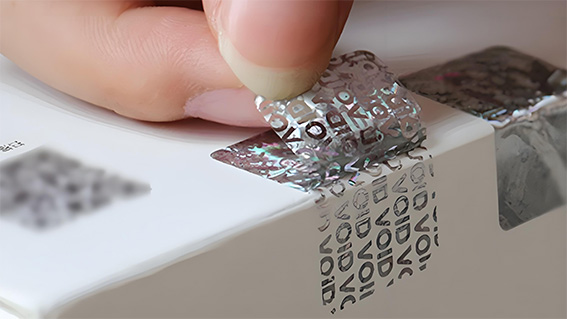
VOID anti-counterfeiting label rely on a physically destructive structure that leaves marks upon peeling, delivering tamper-proof protection at low cost.
Analysis of the VOID anti-counterfeiting label