
Thermal paper self adhesive is a common type of label material
author: Eva
2025-10-08
Thermal Paper Self-Adhesive: Composition, Advantages, and Applications
Thermal paper self-adhesive is an important material widely used in modern information identification and management. It mainly consists of five components: base paper, thermal coating, protective layer, pressure-sensitive adhesive, and silicone paper, each playing an indispensable role.
1. Material Structure and Function
The base paper, as the foundational support layer, is typically made of high-quality paper to provide necessary support and strength for the entire label.
The thermal coating contains heat-sensitive materials that change color when heated, serving as the core layer for information printing. The protective layer plays a key role in shielding the thermal coating, effectively preventing damage from external factors such as friction and moisture.
The pressure-sensitive adhesive on the back of the label is crucial for enabling firm adhesion to various surfaces. Its performance directly determines the label’s sticking effect and durability. Silicone paper is mainly used to protect the self-adhesive layer. It is peeled off during use to apply the label smoothly onto the target object.
2. Performance Advantages and Limitations
Thermal paper self-adhesive offers significant advantages in printing: it does not require ink. Using the heating element of a thermal printer, it can directly produce clear text, images, barcodes, and other information on the thermal paper. This printing method is not only fast but also extremely simple to operate. Compared to printing methods that require ink or carbon ribbons, thermal paper self-adhesive is relatively low-cost, making it particularly suitable for scenarios requiring large quantities of labels.
Additionally, thermal paper self-adhesive can achieve relatively high printing resolution, resulting in highly clear text and images, greatly improving label readability and recognition. In terms of adhesion, the self-adhesive layer performs well, firmly sticking to various materials such as plastic, metal, and paper, and remains durable over a certain period.
However, thermal paper itself has some limitations: it has poor water resistance and is easily damaged by water exposure. Its tolerance to certain chemicals is also relatively weak. To address specific application needs, specialized versions with features such as water resistance, oil resistance, and alcohol resistance have been developed.

3. Broad Application Fields
Thermal paper self-adhesive has a wide range of applications. In the logistics sector, it is often used for printing cargo labels, such as express shipping labels and logistics tags, facilitating tracking and management of goods.
In commercial settings, it can be used to produce price tags and promotional labels, allowing for quick printing and updating of product information.
In the medical field, thermal paper self-adhesive is frequently used for drug labels, patient information tags, test report labels, and more, meeting the industry's strict requirements for accuracy and clarity of labels. In office environments, it can be used for file classification labels, archive tags, etc., aiding in document organization and management.
4. Professional Application Recommendations
Thermal paper self-adhesive is an ideal choice for express waybills and warehouse labels. On sorting assembly lines, thermal printers can instantly complete shipping label printing, well meeting the demands of high-speed operations.
In supermarket applications, receipts, electronic shelf labels, and food expiration date labels have been widely adopted due to their lightweight and eco-friendly properties. Their instant printing capability allows quick response to promotional price adjustments, while water- and oil-resistant variants can adapt to refrigerated displays or damp environments.
In the medical industry, thermal labels are used for test tubes and pharmaceutical packaging. Their alcohol-resistant wiping feature meets disinfection requirements. In industrial settings, equipment inspection labels or short-term warning signs can withstand oily environments and leave no residue upon removal.
When using thermal paper self-adhesive, ensure that the thermal printer’s resolution matches the paper’s sensitivity. In high-speed sorting scenarios, it is recommended to use high-sensitivity paper to prevent blurry printing. Medical or precision labels can be paired with high-precision printheads to enhance graphics and text clarity.
Analysis of PE Label Materials
In-depth Analysis of Glossy Paper Self-adhesive Labels: Materials Science, Printing Technology and Application Innovation
Related Article

Las etiquetas PET resisten el arrugamiento, la deformación, la pérdida de tinta, el cambio de tamaño y el manchado por tinta durante la producción a alta temperatura y la impresión digital con láser.
Comprehensive Analysis of PET Self-adhesive Labels
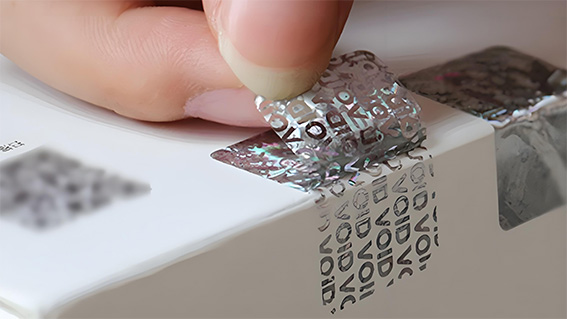
VOID anti-counterfeiting label rely on a physically destructive structure that leaves marks upon peeling, delivering tamper-proof protection at low cost.
Analysis of the VOID anti-counterfeiting label