LOGO labels: Die-cutting difficulty, printing compatibility and common material analysis
author: Eva
2026-05-20
The LOGO labels, as the core carrier for brand visual communication, is widely used in various scenarios such as product packaging, promotional materials, and office consumables. Among them, the self-adhesive material is chosen as the mainstream option for LOGO labels due to its convenient sticking and strong adaptability. Many enterprises, when customizing self-adhesive LOGO labels, often pay attention to three core issues: whether the die-cutting is easy, whether the printing is smooth, and which materials are mainly used during production. This article will, based on the production characteristics of self-adhesive labels, analyze and break down these issues one by one.
I. Is the die-cutting of LOGO labels difficult?
Die-cutting is a crucial process in the production of self-adhesive LOGO labels. The core of this process is to precisely cut the printed self-adhesive material according to the design shape of the LOGO, so that it can be separated from the backing paper and be easy to stick. Many people are concerned that the die-cutting process is difficult and may result in problems such as frayed edges or inaccurate cutting. In fact, the die-cutting difficulty of self-adhesive LOGO labels is generally controllable. It mainly depends on three core factors, rather than just being easy or difficult.
1. Core influencing factors of die-cutting difficulty
The first is the design shape of the LOGO: regular shapes such as circles, squares, and rectangles have the lowest die-cutting difficulty. They can be completed using a common flat-press die-cutting machine, with high cutting accuracy and less deviation. However, for irregular shapes, the die-cutting difficulty will increase, and special die-cutting templates need to be customized. Moreover, the pressure and speed adjustment requirements for the die-cutting machine are higher. If the parameters are set improperly, problems such as frayed edges, incomplete cutting, or excessive cutting may occur.
Secondly, regarding the size of the labels: The larger the LOGO labels, the lower the die-cutting difficulty, because larger labels have a higher tolerance for cutting precision; conversely, for small-sized labels, they are prone to positioning deviations during die-cutting, and high-precision die-cutting equipment is required to ensure accurate cutting.
Finally, the thickness of the self-adhesive material: For the thin version, the die-cutting process is relatively simple, the cutting is smooth, and there is less risk of knife jamming or burrs. For the thick version, due to the harder material or uneven thickness, a greater pressure needs to be adjusted during die-cutting, which slightly increases the difficulty. However, as long as the equipment is compatible and the parameters are reasonable, perfect die-cutting can still be achieved.
2. Tips for reducing die-cutting difficulty
For enterprises, if they want to reduce the die-cutting difficulty of LOGO labels, they can avoid overly complex and irregular details during the design stage. For example, small sharp corners can be changed to round corners, and the dense distribution of complex curves can be reduced. At the same time, reasonable label size settings can be made to avoid overly small designs. Choosing self-adhesive materials that are compatible with the die-cutting process can also effectively improve die-cutting efficiency and yield. In general, as long as the design is reasonable and the equipment is in place, the die-cutting of self-adhesive LOGO labels does not need to be overly worried about, and it is a mature and easily achievable production process.

II. Is Logo Label Printing Easy?
The printing effect of Logo Labels directly affects the brand image. Many enterprises are concerned about whether the Logo Labels can be printed well. In fact, self-adhesive Logo Labels have extremely strong printing adaptability. Most design schemes can be realized through appropriate printing techniques. The key lies in matching the printing process and materials, rather than simply being easy or difficult to print.
1. Core Criteria for Printing Adaptability
The core of good printing is high color reproduction accuracy, clear patterns, no easy detachment, and adaptability for mass production. The printing adaptability of self-adhesive labels mainly depends on two aspects: one is the complexity of the LOGO design, and the other is the surface characteristics of the self-adhesive material.
For simple single-color logos, almost all self-adhesive materials can be easily printed. Using offset printing or flexographic printing techniques can achieve clear presentation with extremely low printing difficulty and high production efficiency for batch production. For multi-color logos, gradient logos, and logos with fine lines, the requirements for printing techniques and materials will increase. It is necessary to choose materials with a smooth surface and good ink absorption, and combine with high-precision printing techniques such as screen printing and digital printing to ensure accurate color reproduction and clear, non-blurred lines.
It should be noted that if the LOGO requires special effects such as metallic texture, fluorescent effect, contrast between matte and glossy finishes, etc., it is not difficult to print, but it requires the selection of corresponding special printing techniques and the use of specific materials to achieve the desired effect. The production cost will slightly increase.
2. Applicable scenarios for common printing techniques
When choosing the printing technique for self-adhesive LOGO labels, it is necessary to combine the LOGO design and the usage scenario: offset printing is suitable for single-color and two-color regular LOGOs, with high cost-effectiveness for batch production; flexographic printing is suitable for multi-color and gradient LOGOs, compatible with various self-adhesive materials, and has a fast printing speed; screen printing is suitable for fine lines and special effects, with high color saturation; digital printing is suitable for small-batch and personalized LOGOs, no need for plate-making, flexible and highly adaptable, suitable for short-term and small-batch customization.
III. Main Production Materials of Self-adhesive LOGO Labels
The production materials of self-adhesive LOGO labels are mainly divided into three parts: "surface material, adhesive, and backing paper". Among them, the surface material is the core factor determining the texture, printing effect, and application scenarios of the labels. The adhesive and backing paper affect the sticking effect and production convenience. The common materials used for self-adhesive LOGO labels on the market are mainly classified according to application scenarios. The following are the most mainstream types of materials and their applicable scenarios.
1. Common Surface Materials
The surface material directly determines the appearance and durability of the LOGO labels. It is the core factor for enterprises to choose. Common types are divided into the following four categories:
(1) Copperplate paper self-adhesive: The most commonly used and cost-effective surface material, with a smooth and flat surface, good ink absorption, suitable for printing single-color and multi-color regular LOGOs, and applicable to various processes such as offset printing, flexographic printing, and digital printing. The advantages are low cost and clear printing effect, but it is not waterproof or wear-resistant. It is suitable for short-term indoor use and is the preferred choice for most enterprises.
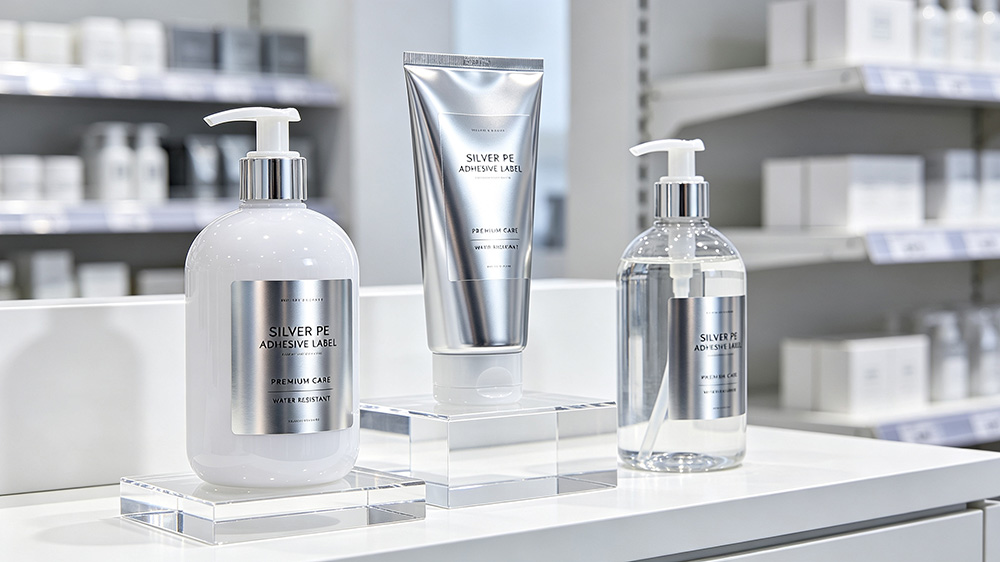
(2) Matte Silver Paper/Lustrous Silver Paper Self-adhesive: This is a metallic surface material with a matte or glossy metallic luster on the surface. It is suitable for logos that need to highlight a high-end feel. The advantages are strong texture, water and wear resistance, and distinct color contrast after printing. The disadvantage is that it costs more than coated paper, and it is suitable for scenarios where there are high requirements for brand image.
(3) PET self-adhesive: It is made of plastic material and is divided into transparent PET and colored PET. Its features include waterproof, oil-resistant, wear-resistant, and heat-resistant, making it suitable for outdoor use and also for labels that need to be preserved for a long time. The advantages are strong durability, less prone to deformation and fading. The disadvantage is that the cost is relatively high. Special inks are required during printing, and it is compatible with screen printing and UV printing.
(4) Specialized self-adhesive paper: This includes kraft paper, frosted paper, and brushed paper, all with unique textures on the surface. They are suitable for LOGOs that require highlighting individuality and a retro style. The advantages are their distinctive texture and the ability to enhance brand recognition. However, some specialized papers have poor ink absorption, so adjustments to the printing process are necessary, resulting in slightly higher costs.
2. Common adhesives
The adhesive determines the sticking force of the label and the applicable scenarios. There are three common types: permanent adhesive, removable adhesive, and low-temperature adhesive. Enterprises can choose based on the sticking requirements.
3. Common backing papers
The backing paper serves to support the substrate and adhesive, facilitating die-cutting and sticking. Common types include Glazing paper backing and kraft paper backing. The selection of backing paper mainly depends on the substrate and die-cutting process, and there is no need for a separate deliberate choice.
IV. Self-adhesive LOGO labels, easy to produce and highly adaptable
Overall, the die-cutting difficulty of self-adhesive LOGO labels is generally controllable. As long as the design is reasonable and the equipment is compatible, precise cutting can be achieved; the printing adaptability is extremely strong. Whether it is a simple or complex LOGO, it can present a clear effect through the appropriate process; the production materials are diverse, and the most cost-effective solution can be selected based on the usage scenario and brand requirements.
For enterprises, when customizing self-adhesive LOGO labels, there is no need to overly worry about the difficulty of die-cutting and printing. The key lies in clearly defining one's own requirements - such as the usage scenario, brand texture requirements, batch size, etc. Then, by combining the above materials and process suggestions, one can customize LOGO labels that are both beautiful and practical, effectively conveying the brand's visual image.
The PET and PP films produced by Instiker not only have excellent printing quality but also have strong adhesion. They are the preferred choice for many customers. If you are also interested, please contact us.
Difficulty in printing glossy labels, ink smudging and solutions
Analyze the printability of product label printing and the potential risks of ink leakage
Related Article

Las etiquetas PET resisten el arrugamiento, la deformación, la pérdida de tinta, el cambio de tamaño y el manchado por tinta durante la producción a alta temperatura y la impresión digital con láser.
Comprehensive Analysis of PET Self-adhesive Labels
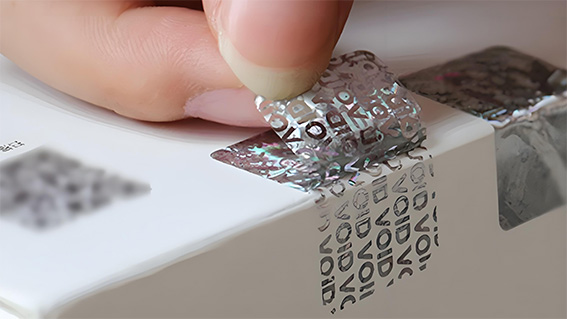
VOID anti-counterfeiting label rely on a physically destructive structure that leaves marks upon peeling, delivering tamper-proof protection at low cost.
Analysis of the VOID anti-counterfeiting label